
A CONVERSATION WITH ADELE BERTEI

Hello thanks for tuning in to my substack today. I recently sat down with fellow Angeleno Adele Bertei to discuss her new memoir No New York (a wonderful book which I highly recommend), her former band with James Chance - The Contortions, as well as Adele’s writing and musical career.
I found Adele’s warmth, strength, and insights so inspiring. I am sure you will too. There are some hilarious anecdotes scattered throughout the interview but I won’t spoil them for you.
This interview has been edited and condensed.
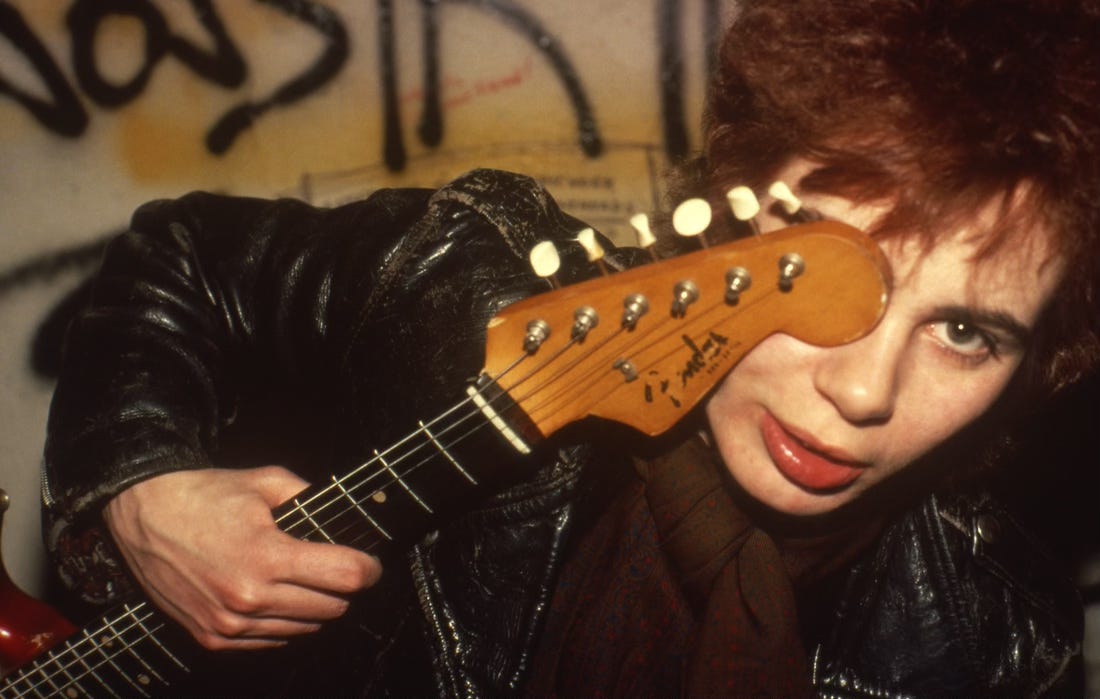
Adele Bertei photo by Nan Goldin
Adam: My questions are a little all over the place Adele so apologies in advance. I was introduced to you when I got into the Contortions in my early 20’s in the late 90’s/early 2000’s and from that point on I would sometimes see your name around. I knew who the Bloods (Adele’s band after she left The Contortions) were but I had never heard The Bloods just because I never came across your records at record stores. Then when your memoir Twist came out I saw it on the shelves at my library. This was maybe 4-5 years ago. I said to myself, “Adele Bertei from The Contortions?” But I was aware that you had a singing career too. So anyway when I read Twist I was completely blown away by it. I ended up sharing it with friends and family, even my mother read it. She thought it was great. Then when your latest book No New York came out I picked it up at Skylight Books here in LA. I was really excited for it and reading the book just sort of sent me down this youtube wormhole where I ended up watching a lot of music videos, performances and interviews with you and I just think that your life/trajectory is very interesting, and so that’s why I wanted to do this interview. So it’s not necessarily going to be No New York focused. I also wanted to use my substack to be able to give shine to other artists whom I really respect and hopefully have conversations that fall outside of the realm of a lot of interviews I read.
Adele: Well thank you and I’m flattered by the attention and the fact that you read my trauma sweepstakes memoir (laughs). I mean Twist was actually auto-fiction because I had to create a character to crawl through all of those foxholes again.
Adam: How did you do that?
Adele: Well therapy helped (laughs).
Adam: Yeah (laughs). As I was reading No New York I kept on wondering to myself, is she a therapist? Because I’ve gone to a lot of therapy too and just the way you write about some things sometimes sounds like it’s from a therapized point of view (laughs).
Adele: I do have a therapized point of view that’s for sure. I’d be making a lot more money if I was a therapist as opposed to being an artist but yeah, I had to basically create a character based upon myself. Obviously the auto-fictional way was the best way to go, but having said that, it all really happened. I just had to frame it in a way that gave me a little bit of armor to go into the war zones.
Adam: While reading your latest book No New York, because of your connections to some of the characters in the book, like The Contortions for example, I was curious how you reconcile your legacy being tied to people who treated others and yourself so poorly at times. Were you able to forgive them? Did you ever get any closure with people like James Chance or Anya Philips and how does it feel to be part of something that becomes mythologized when you’ve also seen the ugly sides of it too?
Adele: It’s an interesting question. I had to approach it from a very psycho-therapeutic angle as I got older. Like, what makes people… what turns people cruel or angry or violent? And basically this is something Pema Chödrön talks about, it all comes from heartbreak. And when people have broken hearts, be it as children, or something that might happen to them traumatically, if they haven’t been able to assess those particular wounds in a way that they understand how to alchemize them and turn them into something that’s actually strength-giving or courage-giving, you know, they become violent. I mean, we’re seeing that in our society written large right now. I think America is suffering from a broken heart and a lot of the people that feel they’ve been abandoned by this system have been hypnotized into, and gaslit into this crazy fascism. But I digress right now.
Adam: No, that’s really beautiful.
Adele: Thank you, but I think that with people like James and Anya, it started out as a cool facade about like “we’re so untouchable and we’re so existential and we hate everything.” This was just a pose. It was really a pose because beneath it, they were very tender creatures and I had to realize that. When you’re going through it, if you’re being oppressed by those kinds of personalities and attitudes it’s hard. Some people just stay and allow it to happen to them, because it’s familiar, being treated badly. The familiarity of it can be more comforting sometimes than leaving it for the unknown, for something a lot kinder. I was a runner. I’ve always been a runner. If you’ve read Twist you know that about me. The moment that something would come up that felt oppressive or cruel, I was gone. And I think that happened with The Contortions. I left when things got too ugly. And it’s a pattern I’ve developed. And as I’ve gotten older it’s like, yes I have forgiven them. I had closure with James. James and I played together a few years before he died. And you know, I wasn’t looking for closure in terms of an apology or accountability. Sometimes there are certain people that are never going to give that to you.
Adam: Oh yeah I do for sure (laughs).
Adele: Yeah (laughs). So it’s up to you really to be able to say “I can’t wait for this.” I have to walk. I have to be ok with it and forgive. You know it’s the same thing with our parents. We can be abandoned or treated cruelly or violently or sexually abused. What do you do with that? A lot of people can’t figure it out.
Adam: It’s hard.
Adele: It really is. It takes a lot of self searching. It takes a lot of surrender to the fact that you’re not going to get accountability all the time, or apologies. And it’s really about self-care and self-nurturance and understanding that there’s plenty of us out here in the world that are kind.
Adam: Yeah.
Adele: Where you can be in fellowship with people that are going to treat you well.
Adam: I really like that part in the book where you talk about recognizing god as seeing the kindness in others. I mean, I’m kind of paraphrasing but I just thought that was so beautiful. I highlighted that. It was a really good way to put it.
Adele: Thanks. Yeah, for me it’s the only way to live because there’s so much unkindness in people these days.
Adam: For sure, it’s a constant choice. I feel like so many people in music… they’re either all out narcissists or some of the most empathic people. A lot of the times, it seems like there’s not many that land in the middle. It’s usually either end of the spectrum and not much in between.
Adele: I think you’re right. Bands are incredibly difficult because you’ve got so many different personalities with different agendas.
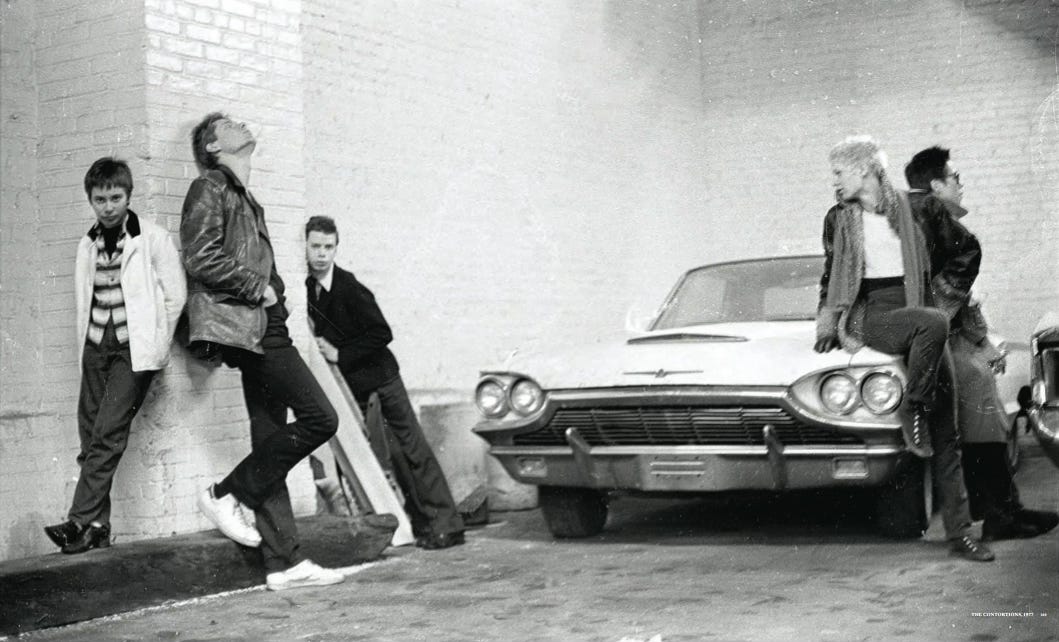
Adele (on left) with The Contortions in 1977
Adam: How did you end up reconnecting James Chance later I’m curious?
Adele: It’s kind of foggy but I believe one of his band members got in touch with me and said “oh you’re in LA, I’m playing with James at Zebulon and he was wondering if you’d want to get on stage and sing for a moment?” So that’s kind of how it happened. So he did indirectly reach out to me, which I thought was lovely. And you know I was very, very fond of James Chance. And sad that he became addicted to heroin, and that cruelty kind of took over his approach to other people for a while. It was a narcissism that took over and was very unfortunate. I mean, I also believed that James Chance was autistic and people didn’t really talk about that and he would probably never have gotten a diagnosis for it either. So maybe the pain of that nudged him towards heroin? I mean heroin addiction is really about covering up pain. That’s the bottom line. But yeah, we had so much fun together in the early band!
Adam: Yeah, I mean reading it…. all those anecdotes!
Adele: We really, really did.
Adam: Reading about it, it just feels like such a special time and I mean I don’t know, I’m not 20 anymore so I don’t know what kids are doing today but reading all the reflections from that era has long been an inspiration for me because those times just seem really free in a way, with lots of people from lots of different worlds intersecting and making something beautiful.
Adele: One of the most magical things about that time, which is very different from where we are today, and hopefully we might be able to slide back into a more open consensus of feeling between all of these seemingly disparate groups of people. But back then, academics would hang out with working class people. There weren’t a lot of black and brown people in the scene unfortunately but that started to change in the early eighties with hip hop, and the arts scene, and the graffiti scene. But also in terms of sexuality, people weren’t so self-defining as we are today. And I think a part of that had to do with being very anti-capitalist and anti-commodification. It was like, don’t slap labels on our asses. You’re not gonna sell to us and we’re not gonna sell ourselves down the river for you. And you know… that was very much a part of our ethos. And a lot of the artists today, it seems like because economically we’re so f-ed up that if you do wanna make art, you’re trying to commercialize it so you can make money from it. And you know, as people like David Bowie often counseled, you cannot play to the crowd. You cannot play to anyone else but your own idiosyncratic desires to make work. Because once you play to the crowd, you know, the art sucks (laughs).
Adam: Right haha.
Adele: You’re not being true. You’re not being authentic. You’re not being interesting anymore. You’re just being like the next guy who you think is being successful or making money. It’s part of this corporate weird fascism that we’re going through right now. Influencers.
Adam: Yeah I know.
Adele: I would hope that the book might inspire a different lens of how we could be as artists together. And get off of our fucking phones and be with each other.
Adam: Seriously (laughs) I couldn’t agree more. Trying to create work while trying to play to the crowd in that way, ultimately you’re just severing yourself from the thing that made people respond to you in the first place.
Adele: Yeah, yeah. I mean I think no wave was different from new wave and punk in that we weren’t really looking for commercial record deals you know?
Adam: Right (laughs).
Adele: There were tiny little independents downtown and you could put out a single and buy it at the local record stores which would carry the indie singles. And we’d all buy them and all support each other. And because of what we were saying, and as you know, there was a lot of cacophony in No Wave, and a lot of political lyrics. I remember one time we were playing at Max’s Kansas City and I think I write about this in the book…. we would have to do two sets because Max’s would pack the house for the first set and there’d be a rumble in front of the stage with James and several of us (laughs). Which crowds loved. And then they would empty the room and bring in another audience. So between the two sets, someone came backstage and told us that Clive Davis had been in the audience for the first set and twenty seconds into the first song, he fled the room. And we were all celebrating “yeah we chased Clive Davis out of the room!” But that’s kind of it. It was like NO! It was a big N-O to all of the corporate distractions that could potentially destroy the work, really.
Adam: One of the things I really appreciated about your latest book is that while you were part of a scene that is heavily revered, you write about those times with no fluff. It’s brutally honest which is refreshing to me in a memoir. It doesn’t glorify the moment. It also doesn’t read like it was written with the intention to settle scores but just to tell your story. So I was just wondering if you could elaborate on that a little bit.
Adele: It was really important for me to tell… and I even say this in the preface…this is my version of a scene. And a lot of people might not agree with my version, or how I consider it or describe it. But for me it was very much kind of walking a tight rope about whose story is mine to tell, aside from my own. And how do I honor people and respect their privacy without compromising my own truths about how certain people affected me, had a profound effect on my life? So I really had to weigh all of those decisions in the writing. It was difficult. It was challenging at times. And sometimes I would ask someone “how do you feel about me saying this?”
Adam: That was going to be my next question. So if you were writing about somebody you would reach out and ask, “how do you feel about me saying….?”
Adele: Yes, in a couple of instances I did do that and was given permission to use what I had written. So if I was gonna school any potential memoir writers about it I would just say the same thing, you can’t be afraid to tell your truth but you also have to figure out what would be upsetting to divulge about another human being to that human being. And if it’s the question, pass it by them. Send it to them. You know? And see what they have to say. You might be pleasantly surprised.
Adam: That’s great advice….. The other thing that I found really interesting too and sorry, this is like my last Contortions question but after reading your recollections of recording with the band, I never knew that you didn’t perform on the album Buy.
Adele: No. I don’t think so.
Adam: I don’t think from reading your book you were on it. You’re only on the No New York recordings?
Adele: I’m on No New York and I’m on James White & The Blacks.
Adam: Ah ok. I actually never have listened to James White & The Blacks. But I just thought it was interesting because I never really liked Buy. I always wanted to like it. I thought the cover art and concepts were cool but the music just felt kind of flat & stiff, like the life had been stripped out of it. So to read your recollections of your experience in the band and recording with the band corroborated something that I just had always felt instinctually but had never really consciously noted until until recently.
Adele: I think people were so disgruntled in the band at that point. I think this was the album (Buy) that George Scott, our original bass player had played on, and as I mentioned in the book… the more successful The Contortions were, the less money we were making. And the money was all going into the pockets of James and Anya. And people were getting really upset about it. I was the first to quit and then George left during the Buy sessions and James Chance just wiped all of his bass parts off and re-recorded them with another player. And so I think that when there’s a certain kind of malevolent vibe that comes into a band where there’s competition and anger and jockeying for power, etc., and money problems… You’re gonna hear it in the music.
Adam: Yeah. For sure.
Adele: So, I agree with you. I didn’t like Buy. I didn’t.
Adam: I didn’t really like anything he did after No New York. To be honest.
Adele: (laughs)
Adam: Sorry (laughs). I always wanted to like it. But I didn’t.
Adele: For No New York, there was something really extraordinary about the band and working with Eno in that moment. Thank goodness Brian captured us in the way that we really sounded when we played live. So for the Contortions as a phenomenon at that moment in New York City, it’s glaringly apparent on No New York.
Adam: Yeah.
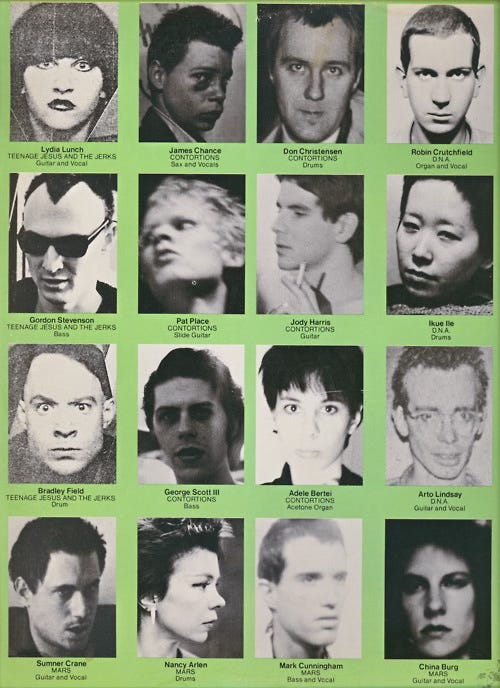
Adele: It was a very, very exciting recording session. I mean, you know we played that stuff live. We didn’t do any overdubs.
Adam: You can tell. I just listened to it the other night. I hadn’t heard it in years. And I was just like wow. I love it when you hear something and you haven’t listened to it in a long time and it still sounds fresh. That to me is the mark of really great art.
Adele: Amen. Yep, we were captured on that one.
Adam: I’m glad that those moments were captured for the rest of the world to enjoy……. Since you were part of the New York music and art community at such a special and vibrant time, I wanted to ask if there was a moment when you started to see the change that was occurring where it began to transition into what came after it, like the yuppie culture? The beginning of the New York that it is now.
Adele: You mean when did that start to happen? The changeover?
Adam: Yeah.
Adele: I think in the early eighties… Eighty one, eighty two. Heroin had really taken root in the East Village and the Lower East Side which is where we were all living. I believe because there was so much going on artistically that had a very political frisson as well, that suddenly the area was flooded with heroin. This happened during the Black Arts movement in Harlem, where Harlem was flooded with heroin during a very beautiful, incredibly revolutionary moment in Black politics and art, in Harlem. It is a way of neutralizing a people, a movement, a revolution. So that started happening in the early eighties. Actually it was happening a little before that but it really felt like it was everywhere. You couldn’t swing a stick and not hit a junkie or a dealer. And then also there was AIDS. AIDS came into the picture in the early eighties and was terrifying. And I think by nineteen eighty three there were maybe six hundred cases in New York alone of deaths. And everybody was getting sick. And everybody was scrambling to figure out a cure and that’s when eventually Act Up formed to fight for the drugs, etc. So between heroin, AIDS, and gentrification that came in because of all of the renovations and beauty that we were creating downtown, real estate developers started to say “hey this is going on.” Because a lot of people were able to buy lofts in old tenement buildings for like five grand. Collectives were forming in these abandoned buildings and people would buy them from the landlords.
Adam: Five grand? Crazy! (laughs)
Adele: Yes! And they would start renovating. And then real estate developers started seeing what was going on so they moved in as well. I think between the three entities it just started to dissolve. A lot of artists started going their own ways individually. It was a very sad time. Probably by the mid eighties it was pretty tragic, especially in the gay community because we were losing so many.
Conversion drifts over to Cookie Mueller….
Adele: Yeah because I knew Cookie and she was another tragic loss from AIDS. If you look at my book, in one of the opening pages there’s a spiral of names of people that died. Many of them from AIDS, many of them from heroin overdoses, many of them from just accelerated illnesses due to drugs and alcohol as well. So it was a really hard time to live under the specter of the fear that you might have AIDS, but also the grief. And that’s one of the reasons I also embraced dance music at a certain point because dance music was a way for the queer community to shake off our grief and celebrate one another and celebrate life in the midst of all that darkness and death. I wanted to contribute to that idea of we’re still here, there’s still joy, and we have to embrace life for the ones who’ve gone. That’s what they would want, really.
Adam: That’s actually a great segue to what I wanted to ask you about the dance music stuff you did and your career post Contortions and after The Bloods too. I’m just so curious. How did that come about for you? Because people knew you were a great singer? Or because it was a small community that you were all close enough? You knew Madonna well enough to work on music together in her early days as you talk about in your book.
Adele: After I left The Bloods I would do solo gigs with backing tapes that I would put together. I’d sing live with tapes, sometimes play a bit of guitar and I was kind of running the gamut of songs I would do. Like “Harlem Shuffle” and then do a version of Bertolt Brecht and Kurt Weill’s “Pirate Jenny.” And there was a guy named Danny Heaps who would come to see some of these shows and he had gotten a job at the newly formed Geffen label. And he approached me. He said “hey would you like to do some demos for Geffen?” Which I did, with my bass player who I was still working with from The Bloods, Brenda Alderman. One thing just came after the other and I got signed to Geffen but then as soon as I was signed they wanted to control me. I thought they wanted me because of my authenticity.
Adam: Right (laughs).
Adele: Which was you know (laughs), fool me once…. I’ve been fooled many times by the music business. So I ended up working with Thomas Dolby, who I really enjoyed working with. He produced my first single.
Adam: Did that come about because of the relationship with Geffen?
Adele: Yeah. Geffen introduced me to several people. Lots of managers who horrified me for the most part. People from the guy who managed Peter Frampton to David Bowie’s ex-manager who ripped David Bowie off.
Adam: Was that Tony Defries?
Adele: Yes! I was originally managed by Jane Friedman who was Patti Smith’s manager. As soon as I was signed to Geffen it was like “you gotta get rid of Jane, she’s not powerful enough, you got to get rid of Brenda.” And basically they would never say it out loud but because she was a black lesbian, they didn’t want me working with her. They didn’t want me to be gay. They didn’t want me to be myself basically. So they took away all the women that were my support structures at that moment and then started introducing me to all these powerful men in the business. And it was a shitshow. I saw through it all. Except for Tom. I really liked Thomas (Dolby) and we worked well together. I worked with the keyboard player from Chic as well, Raymond Jones. I wrote “Build Me A Bridge” with him. And also used some of Lesley Woods’ lyrics, from the Au Pairs for that song.
Adam: That’s so cool.
Adele: Just a very strange combination of bedfellows there, you know?
Adam: I know. Reading about that stuff I just thought to myself wow this is such a disparate mix. I never knew there was an Au Pairs / Chic connection.
Adele: (Laughs) yep! So Thomas produced the first single. The dance single went to number five in the dance charts. Completely surpassed Madonna’s first single. And that’s when she started getting bitchy with me unfortunately (laughs). Female competition, you know. “There’s only room for one.” And from the downtown scene it was either me or her and she was a very straight woman and I was out of the closet and very butch. And then basically there was a mistake made. Mark Kamins did a remix of “Build Me A Bridge” for the dance floor and he exposed a mistake that Thomas made on the keyboards because we weren’t sequencing then. Thomas was playing the keyboards live on the recording. Thomas was furious because he wasn’t consulted about the remix so he didn’t want to do my album, which was horrible. He wouldn’t work with Geffen but he did love my voice enough to ask me to come to England and work with him on “The Flat Earth.” Which gave him his second big hit, which was the duet “Hyperactive.”
Adam: I watched the youtube footage of that. I’ve watched it a few times. I mean you’re kind of the best part of that song if you ask me.
Adele: Aww thank you.
Adam: I mean when you come in, it’s just wooo, it’s so powerful. It’s really cool.
Adele: I thought it was a really interesting record for the time. I mean, I love eighties dance music and pop music.
Adam: Yeah me too.
Adele: I think it’s incredible. The thing about pop music that people don’t like is that it sounds so commercial. To me that’s a bullshit argument. To create a really good pop record… you’re creating joy. Especially when the lyrics were great too during the eighties. You know, you’re also creating introspection but with this kind of pop shimmer that’s just, well, it’s not easy to do.
Adam: No it’s not at all. Speaking as somebody who has worked on the periphery of it. No. A lot of people really do not understand how hard it is. I honestly think it’s like the most difficult thing musically that one can try to do.
Adele: Oh yeah. It’s a magical skill. And if you can pull it off it’s amazing. Because it does give people joy and it does make people think when the lyrics are great.. You know. And are relatable. It’s magic, it’s just magic. In terms of my musical history I’m all over the place in what I like. I’ll listen to Rahsaan Roland Kirk and then Wolf Alice who I love. I think they’re a good band. I’m all over the place. I always have been. I like the French chanson réaliste singers. Like Piaf and Mistinguett.
Adam: As you moved through the eighties were you able to make a living off of being a singer making the recordings that you did? How did you manage that? I’m just so curious what it was like for artists who weren’t at a Boy George or Madonna level of popularity. I’m curious about what your experience was like as an artist, having these really cool songs but that weren’t number ones on the pop charts for twelve months on end. I’m curious how you survived.
Adele: I had a songwriting deal initially. A publishing deal with CBS songs and then they were bought by SBK and then SBK was bought by EMI. You know, the Russian doll game that the music business plays so that you can never track your royalties. But in the beginning I was getting healthy advances to write songs. And that was part of my side hustle, writing pop songs for Sheena Easton, and then The Pointer Sisters and who else did I write for? I co-wrote a couple songs with Thomas Dolby. So I was working as a songwriter at the same time. I co-wrote with Matthew Sweet.
Adam: You did?
Adele: Yeah (laughs).
Adam: Crazy wow. I had no idea.
Adele: Yeah so I was getting advances from my publishing company for the songwriting. And so that kind of carried me through the eighties but then by the time the nineties hit I had been so disillusioned by what was happening in the music business and with my own career because, I mean, being a gay woman in those days. You know, Ellen Degeneres didn’t come out until the nineties.
Adam: And it was a huge deal.
Adele: Yeah and I was not about to crawl into a closet like Lindsey Graham.
Adam: Right (laughs).
Adele: (laughs)
Adam: Exactly.
Adele: But it’s tough, to get into all the machinations of what happened with record companies. I think what I’m gonna do on my substack, I’m gonna start doing specific stories that didn’t make it into the book that people might be interested in about my foray into working with certain producers in England that turned sour, you know, and people here. There was a lot that happened. There was a #metoo moment that I wasn’t allowed to put in the book.
Adam: Interesting, I was wondering about that because I can tell from reading No New York that there’s so much more.
Adele: Oh yeah.
Adam: I’m just seeing slices of it.
Adele: Oh yeah there’s plenty, but you know when I was writing the book I was basically warned by lawyers to be very careful about what I say because, as we know…. these men in the music business have a lot more money than I do for lawyers. So things like sexual assault, it’s really hard. You can’t prove that stuff years later. It’s kind of impossible. But at the same time I feel it’s important to talk about it because I think a lot of women in the industry have been sexually assaulted or pressed into sexual situations so that they could further their careers and it’s really ugly. Some horrible stories that have gone down that I know about.
It’s sad because we’re in that situation in a cultural moment where women are really being severely punished from the messaging that’s coming down from the people who run our government and our tech. Basically they’re saying pedophelia, sexual assault, all these guys that are involved in this stuff, it’s just like they have impunity for all of it.
Adam: I know.
Adele: And the messages to little girls and women is, we can do whatever the hell we want to you and we’re never gonna pay for it. That’s the messaging and I’m starting to think that the time is going to shift now. It’s going to take awhile. But hopefully the time is shifting.
Adam: I was happy to see how quickly Graham Platner was shot down.
Adele: Mmm-hmm. Should we get back to music (laughs)...
Adam: I can’t remember from the book the exact year you got sober but were you navigating your career in the eighties while not being sober or were you clean while that was all happening?
Adele: During the eighties I was kind of in and out of drinking and drugging. I mean the eighties were so cokey in New York City. I remember even Grace Jones had this restaurant for a moment called La Vie En Rose. And you would walk down a couple of steps and if you were cool, the bouncer knew you and you could come in after hours, after the clubs closed. And she had a big round table where she would hold court. Like probably in the early eighties. And there was a lazy susan in the middle of the table with mounds of coke on it and you would just spin the lazy susan and do lines and you know, it was a party. But everybody was doing coke in the eighties. So…. I followed suit.
Adam: Seems difficult to resist (laughs).
Adele: It was really difficult to resist. Sometimes for The Bloods, backstage someone would show up with a bag of Peruvian cocaine and…. the party was on.
Adam: (laughs)
Adele: So I was doing a lot of coke and a lot of drinking off and on during the eighties. When I got signed, I stopped for awhile but then if something became really upsetting I would indulge again because I didn’t want to feel the pain of what was happening.
Adam: Right.
Adele: And that happened off and on all the way up until nineteen eighty nine. I got sober in nineteen eighty nine and as a gift from the goddesses I landed a job as a background singer for Tears For Fears doing the “Sowing The Seeds Of Love” tour.
Adam: Wow! Did you sing on the recordings or just the tour?
Adele: Just the tour and then on the b-side of one of the singles we did a song called “Johnny Panic and the Bible of Dreams” which I recorded on. And that’s a great track. It was myself, Biti Strauchn, Oleta Adams, and Roland singing on that track and it was pretty formidable. So that was the only recording I did with them but the tour lasted about eight, nine months off and on. We had a couple of breaks.
Adam: They were probably one of the biggest pop bands in the world at that time I would say.
Adele: Yeah, nineteen ninety we were traveling all over the world and it was an amazing, phenomenal tour and a way to experience stadiums, sixty thousand people crowds without having the pressure of being the front person (laughs). Because the front people had to deal with everything whereas when you’re a background singer…. they talk about this in 20 Feet From Stardom, which is a documentary about background singers.
Adam: Yeah, I saw it. Really good.
Adele: Yeah, so that was really phenomenal, that was a gift of early sobriety for me. To be able to continue singing and making a good living.
Adam: How did you land that? Was it because they were people you knew or they were familiar with you or because of management?
Adele: I had been dropped from Chrysalis Records after a #metoo event and the publicist at the time, Francis Pennington was married to Curt Smith from Tears For Fears and she was very supportive of me and she said listen, they’re going out on tour for “Sowing The Seeds Of Love,” they need background vocals. You should talk to Curt and Roland. Which I did. And then I ended up getting the gig, which was pretty amazing.
Adam: That’s so cool.
Adele: Yeah. And I made enough money on that tour that when I came back I could go to therapy twice a week (laughs).
Adam: Hahah…. You were still in New York then?
Adele: I was still in New York and I just said ok, I am finally gonna go deep into therapy and between therapy and AA I learned a lot in those next couple of years.
Adam: When did you leave New York then?
Adele: I didn’t leave New York until nineteen ninety three.
Adam: And you came to LA?
Adele: And I came out to LA because I was really tired of the music business and I wanted to start writing. And I had friends who worked in the music video and commercial business here, producers. So I started ghost writing treatments for directors. And that was kind of my segue into writing. I had always written poetry and had never written anything longform, aside from poetry. So I got involved in writing, in the industry here.
Adam: That’s cool. I’m always curious just about how people manage. That’s neat. So you did that professionally for a while then?
Adele: Yeah I did that professionally for a while and while I was doing that I was working on my first books. Peter And the Wolves was the first one.
Adam: I haven’t read that one yet but I’m going to.
Adele: That’s the one about the Cleveland scene and Peter Laughner and Pere Ubu and the Cleveland scene. How important he was (Peter Laughner) in my life.
Adam: Yeah it sounds like it just from the anecdotes in No New York…. I was curious too, do you have a routine for your writing? Do you block off chunks of the day to work on your writing? Is it an everyday thing? I’m always just curious about people’s creative process. Because mine is a little chaotic.
Adele: When I’m working on a book, when I’m in it, I’m so dedicated. I get up, I have a couple of health rituals I do. Mental health and physical. And then I go straight into writing. I can usually go about six hours a day. When it’s time to work, I’m very dedicated. I get things done. I have a lot of discipline. Which is something I did not have when I was running around New York in the seventies and eighties. Too much happening! Too many cool things! (laughs)
Adam: And no phones. I’m so glad I grew up in the era where there was not the immediacy of the smart phone. I mean obviously there’s nice things about the immediacy of the phone and technology too but it was so exciting to just find your way around.
Adele: Oh yeah. I loved that about New York. You would go out. No phones. No internet. Just go out in the street and you’re going to a little restaurant that everybody hangs out at because it’s cheap. Like a Hungarian or Ukrainian restaurant. And then you’d find out what was happening that evening. Who was doing a gallery thing or who was doing a show and you’d show up and then you’d run into more people and they’d say “hey we’re going over here.” So it was this very human, very communal face to face interaction and then also collaboration, you know. If you were a guitar player and someone was making a film and they liked the way you looked, it would be like “hey be in my film.” So there was all this cross collaboration that was going down. And it was different from punk or new wave because we were doing so many different types of art. We were making films. We were doing poetry, activism, bands, theater. So it was all happening and we were all cross collaborating. So that was another facet that was very different from the previous scenes.
Adam: I feel like when I watch Downtown 81 even though I know it’s a fictionalized piece, I feel you still get the fumes of what that was maybe like. As somebody who was actually around for it, is that movie enjoyable for you to see or is it sort of like…?
Adele: Gee, I haven’t seen it in so long. There’s so many other great films from that time that really capture that ethos of what was going on. There’s Born In Flames by Lizzie Borden. There’s Rome 78.
Adam: Born In Flames you did the soundtrack for right?
Adele: My band the Bloods were in Born in Flames and we did some music for it. I play a lead role. Jamie Nares directed Rome ‘78, and it’s hilarious. They were two of the better films that were made during that time. Jim Jarmusch’s Stranger Than Paradise is a great film. Kiki Smith made a film called Cave Girls. Lynn Tillman made a film about Frances Farmer. There are just so many wild films made by No Wave filmmakers.
Adam: Thanks for telling me that because I haven’t really explored that realm so much. I feel like I’ve only seen a few things and they were kind of inspiring in a way but they were also kind of like so low budget that… not that the budget always determines if something is good or not, but it was just a little hard to appreciate it if I wasn’t there sort of thing, as an outsider viewing it. Is Rome 78 a Beth B film?
Adele: No it’s a Jamie Nares film. Scott and Beth B made a lot of films during that time too. Some of them better than others (laughs). But they also really captured what was really going on downtown.
Adam: You’ve been very generous with your time. I’m not trying to keep you here all day even though I would love to just keep hearing all your stories. It’s really awesome to talk to you.
Adele: Thank you.
Adam: I was curious if you can name some books that have inspired you throughout your life and maybe inspired you to maybe sort of share your journey? No apologies for the use of the word journey either.
Adele: (Laughs) Anais Nin’s Diaries influenced me a lot. Jean Genet’s Our Lady Of The Flowers was an incredible book that made me want to write. Gosh. I loved books by Zola, the French réalistes. A lot of the French poets were very inspiring to me. And I have to say that Patti Smith was very much an instigator for the No Wave scene. If Patti Smith mentioned a book, I would run and pick it up. Virginia Woolf, I love Virginia Wolf, Sylvia Plath. Just so many brilliant writers from the past that inspired me to start writing when I was hitting New York at that moment. Patti Smith is underestimated when it comes to the effect she had on underground culture, outsider culture.
Adam: I can see that. And it’s cool to see that you give her her props for that in the book. Ok so my last question is…. I’m a really big Cookie Mueller fan and I was wondering if there’s an anecdote or a story that you could share about her because you were friends with her right?
Adele: I was friends with Cookie but not good friends like Nan was. Nan Goldin and Cookie were very tight but you know, I’d hang out with Cookie sometimes and she was always really amusing and very sweet. Very smart. But any specific anecdotes I can’t really think of any stories per se.
Adam: She just seems like such a character that whenever I see her on film, I can’t take my eyes off this person. Her energy is so huge, and then her writing is just incredible.
Adele: She was wonderful. I mean she was one of a kind. What I loved about her and which was very indicative of fashion in No Wave, the singularity of it, is that she was like a greaser chick from the fifties.
Adam: (laughs)
Adele: You know? There was a genre called the greaser in the fifties, which is kind of like the film Grease. That film was the greaser look. Cookie would rat her hair really high and wear seamed stockings and I just thought, I grew up with girls like that in Ohio. And so that was her idiosyncratic fashion statement and I loved it and everybody else did too. She was very unique in that regard. A lot of people dressed to their own inner personalities or art and films that influenced them. The boys would dress like the guys in Jean-Luc Godard movies or girls sometimes dressed very androgynously in little suits, like Lizzie Mercier. I adored Cookie.
Adam: Ok last question for real this time. What’s next for you and what are you working on that you can talk about?
Adele: I think it’s ok to announce this but I’m doing a day and an evening of performances at the Getty Museum here in LA on October 4th. And I’m bringing the Bush Tetras out to perform in the evening. It’s called A Moveable Feast of No and I’ll have some people doing spoken word. I’m putting together a women’s guitar army with Hildegard von Bingen tunings, so it’s gonna be wild. And I also have a trio called MITH who will be performing. It’ll gonna be a great day and evening of performances. Ikue Mori from DNA, who is still making music, I think she’s coming out to play with Julianna Barwick. So yeah, good stuff happening. And then in January on the 8th and 9th, I’m directing the Kathy Acker & The Mekons musical called “Pussy, King of the Pirates.” Kathy Acker collaborated with The Mekons on a musical and she only performed it once before she died. So I’m doing that and Kathleen Hanna from Bikini Kill and Alice Bag are going to be singing in it.
Adam: And that’ll be here in Los Angeles?
ADele: That’ll be here at the Nimoy Theater in Los Angeles, on the west side. It’s part of CAP UCLA. It’s beautiful. It’s an old art deco theater. It’s really cool.
Adam: I’ll definitely be going to both of those. There’s so much cool stuff happening in LA still. I tend to be really bad at finding out about it a lot of the time because I’m always really focused on whatever it is that I’m working on, but I’m glad I asked!
Adele: And then the overwhelm of everything coming at us all the time.
Adam: Yeah I know.
Adele: There’s so much going on. It’s hard to parse what to see.
Adam: Well thank you so much and I really appreciate this. I’m so stoked. I’m so glad this could happen. I’ll be in touch!
That’s it for today. Thanks for tuning in! I also highly recommend checking out Adele’s substack.
“The individual has become an endangered species.” -Lydia Lunch
And please consider subscribing if you enjoyed this. My substack is always free!